
Today, the world consumes 104 million barrels of oil and 406 billion cubic feet of natural gas every day, with demand for both continuing to grow.
South Africa alone consumes around 160,000 barrels of oil, 400 million cubic feet of gas and 420,000 barrels of refined petroleum products daily.
Meeting this growing demand while ensuring reliable and affordable energy requires the responsible development of oil and gas resources.
In South Africa, there are currently 14 exploration rights and 7 production rights.
South Africa’s offshore oil and gas potential is significant and it could offer more than resources.
In case of discovery, the sector could attract massive investment, create jobs, infrastructures, support local development and communities.
Success in this sector requires collaboration, transparent practices, and careful stewardship of the marine and coastal environment.
OPASA’s role is to ensure that offshore development is guided by integrity, informed by trusted expertise, and delivered in a way that benefits both the country and its communities. Responsible offshore development is not just about energy – it’s about progress, possibility, and people.
The oil and gas industry explores, produces, processes and delivers fuels that power transport, industry, and everyday life.
It encompasses three segments:
Upstream activities begin with exploration. The objective of the exploration phase is to find oil and gas. To do so, explorers start by acquiring and processing gravity, magnetic and seismic data to determine the location of potential hydrocarbons traps. Once a trap is defined, an exploration well has to be drilled to determine whether or not the identified trap contains hydrocarbons. An offshore exploration well costs tens to hundreds of million dollars, depending on the water depth and the complexity of the well.
On average, in unexplored areas, only 1 out of 10 exploration wells drilled will find hydrocarbons and the exploration phase lasts 2-3 years. Once hydrocarbons are found, the appraisal phase kicks in. Additional wells are drilled to evaluate the volume of hydrocarbons and determine if the discovery is commercially viable. This phase usually lasts 1-2 years.
If the discovery is economical, a development plan is defined. It encompasses the drilling of production wells, the installation of subsea equipment, pipelines and facilities required for the production, treatment, storage and export of the hydrocarbons. The construction of an upstream project varies depending on the size of the project but usually takes 4 years and can cost billions of dollars.
Once production wells are drilled and facilities installed, the production phase can start and it can last for 30 years or more. And when production activities cease, wells and facilities are decommissioned.
The upstream industry is a long-term and high-risk industry, highly capital and technologically intensive. Each stage of an upstream project is highly regulated to ensure safe operations, environmental protection and that the country receives its fair share of revenues.
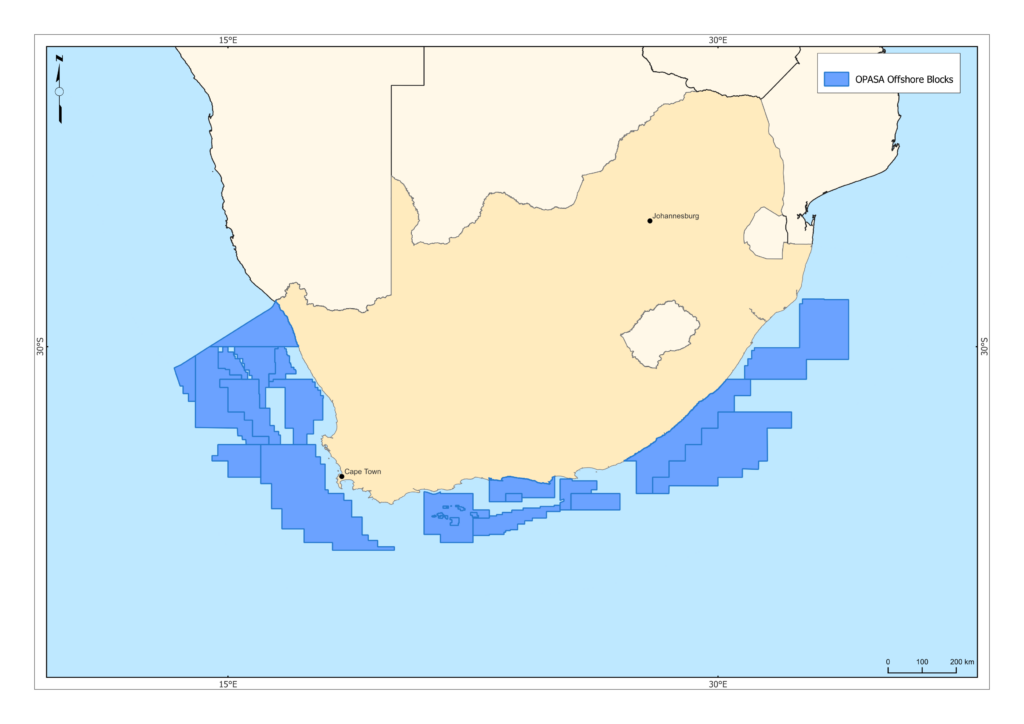
MAP OF SOUTH AFRICA’S OFFSHORE PETROLEUM EXPLORATION
AND/OR PRODUCTION RIGHTS
| Cookie | Duration | Description |
|---|---|---|
| cookielawinfo-checkbox-analytics | 11 months | This cookie is set by GDPR Cookie Consent plugin. The cookie is used to store the user consent for the cookies in the category "Analytics". |
| cookielawinfo-checkbox-functional | 11 months | The cookie is set by GDPR cookie consent to record the user consent for the cookies in the category "Functional". |
| cookielawinfo-checkbox-necessary | 11 months | This cookie is set by GDPR Cookie Consent plugin. The cookies is used to store the user consent for the cookies in the category "Necessary". |
| cookielawinfo-checkbox-others | 11 months | This cookie is set by GDPR Cookie Consent plugin. The cookie is used to store the user consent for the cookies in the category "Other. |
| cookielawinfo-checkbox-performance | 11 months | This cookie is set by GDPR Cookie Consent plugin. The cookie is used to store the user consent for the cookies in the category "Performance". |
| viewed_cookie_policy | 11 months | The cookie is set by the GDPR Cookie Consent plugin and is used to store whether or not user has consented to the use of cookies. It does not store any personal data. |